

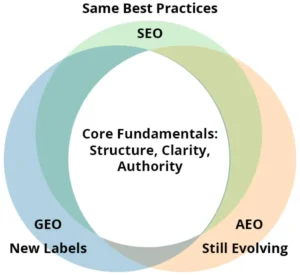
The debate over SEO vs GEO vs AEO has exploded as AI search engines reshape how information is discovered and ranked. Some experts argue GEO/AEO is nothing more than SEO with a new label. Others insist it represents a fundamental shift in how modern AI systems retrieve, evaluate, and assemble information.
After reviewing the arguments, expert commentary, and recent statements from Google, Microsoft, and Perplexity, one thing is clear:
Search is changing—but the industry is still figuring out what to call it.
Why Some SEOs Reject GEO/AEO
Many SEO professionals argue that GEO (Generative Engine Optimization) and AEO (Answer Engine Optimization) don’t differ enough from traditional SEO to be considered new disciplines.
Harpreet Singh Chatha of Harps recently posted a list of GEO/AEO “myths” to leave behind in 2025, including:
“LLMs.txt… Paying a GEO expert to do ‘chunk optimization.’ Chunking content is just making your content readable… Ask your favourite GEO expert for 25 things that are unique to AI search and don’t overlap with SEO. They will block you.”
Source: Harpreet Singh Chatha on X
He also notes that LLMs.txt is not used by any AI search engine, and if it were, SEOs would immediately try to manipulate it—forcing AI systems to cross‑check HTML anyway.
Another criticism:
Some of the loudest GEO/AEO advocates are newcomers with little SEO experience, fresh out of college, pushing tactics that are either basic SEO or outright spam.
SEO pioneer Greg Boser echoed this sentiment:
“We don’t need to come up with a bunch of new acronyms… All that needs to happen is we all agree to change the ‘E’ in SEO from ‘Engine’ to ‘Experience.’”
Source: Greg Boser on LinkedIn
Why GEO/AEO Is Hard to Define
A major reason the debate continues is that many GEO/AEO proponents struggle to explain how it differs from SEO.
Microsoft’s October blog post on optimizing for AI search states:
“Success starts with content that is fresh, authoritative, structured, and semantically clear.”
“Crawlability, metadata, internal linking, and backlinks… are just starting points.”
Source: Microsoft Blog
Microsoft emphasizes that AI search doesn’t rank whole pages—it ranks pieces of content:
“In AI search… it’s less about ordering entire pages and more about which pieces of content earn a place in the final answer.”
This aligns with comments from Jesse Dwyer of Perplexity AI, who explained:
“The AI‑first approach is known as ‘sub‑document processing.’ Instead of indexing whole pages, the engine indexes specific, granular snippets.”
Source: Perplexity AI
This shift—from whole‑page ranking to snippet‑level retrieval—is one of the clearest differences between SEO and AI‑driven search.
Practices Marketed as GEO Are Actually Old SEO

Many tactics being sold as “AI‑ready” are simply good SEO:
- Writing content in answer format (common since Featured Snippets in 2014)
- Chunking content into short paragraphs
- Using clear headings and semantic structure
- Adding structured data
- Ensuring freshness and citations
The only emerging tactic that feels genuinely new is earning citations from authoritative sites so AI systems surface your content in synthesized answers.
Google’s Position: It’s Still SEO
Google representatives—including Robby Stein, Danny Sullivan, and John Mueller—have repeatedly said SEO remains essential because AI Overviews still rely on traditional Google search results.
Google has stated that you do not need GEO or AEO to rank in AI Overviews.
OpenAI recently posted a job listing for a content strategist with strong SEO skills, not GEO—another sign that traditional SEO remains foundational.
Why Some Experts Say GEO Is Different
Manick Bhan, founder of Search Atlas, argues that GEO is not just SEO with a new name:
“GEO is not just SEO with a fresh coat of paint… The machines we’re optimizing for have [fundamentally] changed.”
Source: Manick Bhan on LinkedIn
He explains that AI search engines differ in:
- Retrieval models
- How they fuse and weight sources
- How they handle recency
- Trust and authority signals
- Query expansion
- RAG (retrieval‑augmented generation) behavior
- Logit calibration and temperature
These differences lead to measurable variations in:
- Retrieved sources
- Citation patterns
- Answer structures
- Semantic framing
In other words: The tactics are similar, but the systems are not.
Where the Industry Actually Agrees
The debate feels unresolved because the search ecosystem is still in transition. The real clarity comes from acknowledging:
- There is no stable GEO playbook yet
- AI search engines retrieve and assemble information differently
- Optimization is no longer aimed at a single system
- SEO is evolving, not disappearing
The biggest shift is that answers—not pages—are the output, and content must be structured so AI systems can extract and cite it.
Final Takeaway
The question isn’t whether SEO, GEO, or AEO is “real.” The real issue is that search itself is changing faster than the terminology.
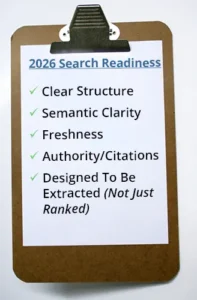
What matters most today:
Clear, structured, authoritative content
Strong citations
Semantic clarity
Freshness
Content designed to be extracted, not just ranked
SEO isn’t dead—it’s evolving into something broader, and the industry is still naming it.